
Welcome to the Met: The Pictures Want a Word
Enter the historical museum
Anjali Arora, 2001. Open the original project entrance, then visit Gallery 1 by day, the night introduction and Gallery 1 at night. These links open historical pages at the Internet Archive.
The entrance advised Internet Explorer 4 or later; archived controls and images can behave differently in a modern browser. For context and a readable route through the transition, use our night-scene guide. The essay below is commentary, not the original museum interface.
Whitney’s Idea Line catalogue records this same project URL as Metropolitan Museum of Modern Paintings.
Pic3 enjoys the attention. Pic2 wants the crowd to leave. That disagreement is the best joke in Anjali Arora's imagined museum: even the paintings cannot agree on what a good visitor should do.
Welcome to the Met gives its pictures an after-hours life. By day, a gallery label places them in art history. At night, they talk about crowds, celebrity and the people trying to sound knowledgeable in front of them. The familiar museum arrangement quietly turns around. The objects are doing the judging.
Fame looks different from the wall
It would be easy to make every painting despise the visitors. Arora does something more interesting. Pic3 likes being admired; the same crowd irritates Pic2. Pic1 and Pic4 question the visitors' sincerity. The room is a quarrel, not a chorus delivering the artist's verdict.
This makes the satire less comfortable. The visitors perform good taste, but the pictures also have reputations to protect and pleasures to enjoy. A painting pleased by its own celebrity is not standing outside the social game. It is another participant.
To my eye, that is where the work becomes sharper than a complaint about pretentious museum talk. It notices that attention has different values for the people caught inside it. What flatters one picture exhausts another.
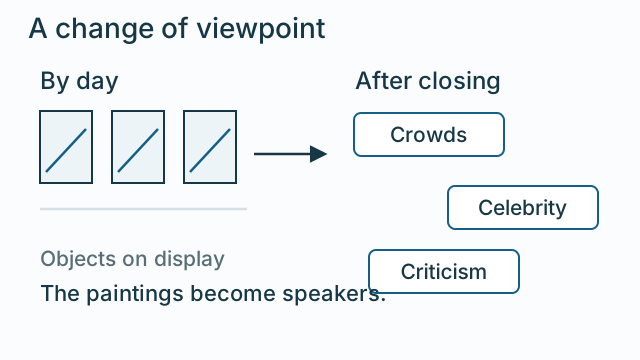
The same room, a different position
The daytime Gallery 1 label gives its paintings a date around 1542. A date seems to settle something: this object belongs here, in this historical order. The night-time conversation replaces that calm classification with preferences and irritation.
Moving between the two pages changes more than the information on the screen. It changes the position from which we look. A picture that was waiting to be classified can now object to the way it is being received.
The pictures borrow the visitors’ language
The dialogue moves between art-critical grandness and conversational “yaar”. That change of register shrinks the distance between solemn museum space and a room full of tired people. The supposedly timeless objects have had a long day on their feet.
There is a counterreading. Giving the paintings the last word could let the work mock every visitor who tries to talk about art. Yet their quarrel makes their authority unstable too: fatigue, vanity and irritation qualify the judgement. We are hearing situated speakers, not finally learning what all art thinks of us.
Reading note
Historical work: Anjali Arora. This reading follows the saved day and night Gallery 1 pages. It does not reconstruct the complete museum. The catalogue titles vary; the original address connects their records. The interpretation and diagram belong to this edition.